The Differentiator No Competitor Can Copy: Custom OEM Software as Strategic Advantage
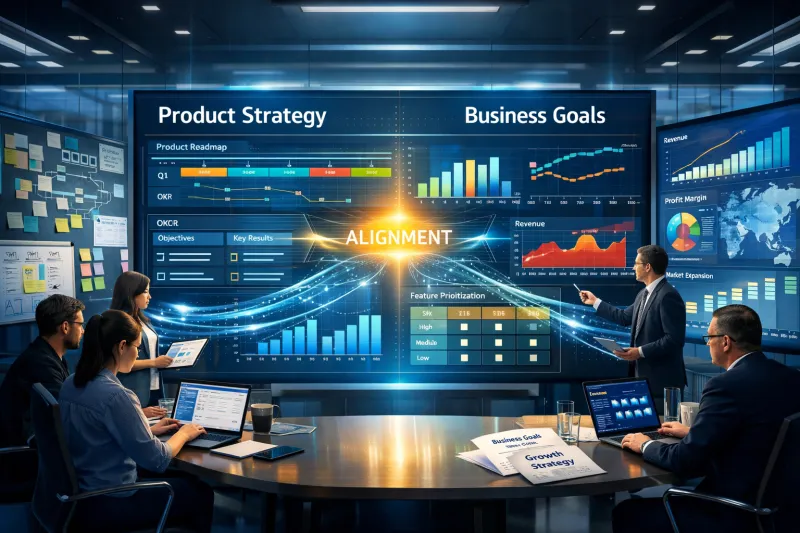
Photo: manufacturing executive reviewing digital strategy competitive advantage technology, via eadn-wc03-16572017.nxedge.io
There is a persistent tendency in manufacturing leadership to categorize software as infrastructure—a necessary cost, an operational enabler, something that supports the real work rather than contributing to it directly. This framing has served large software vendors exceptionally well. It has served manufacturers considerably less so.
The most competitive OEM operations in the United States today are increasingly treating their software architecture not as overhead, but as a core business asset—one that compounds in value over time and, critically, cannot be purchased off a shelf by a rival.
When the Product Is No Longer the Only Product
In mature manufacturing markets, product differentiation narrows. Material specifications converge. Tolerances become standardized. Certifications commoditize. When two suppliers can deliver functionally equivalent components to a tier-one customer, the deciding factors shift to reliability, responsiveness, and the ability to integrate seamlessly into the customer's own operational ecosystem.
This is precisely the terrain on which custom OEM software creates durable competitive separation.
Consider a precision components manufacturer serving the aerospace sector. Two suppliers may offer parts that meet identical MIL-SPEC tolerances. But if one supplier has built a proprietary integration layer that allows direct data exchange with a customer's production planning system—eliminating manual purchase order processing, providing real-time inventory visibility, and triggering automated quality documentation—that supplier is not simply a vendor. It has become embedded infrastructure. The switching cost for the customer is no longer the cost of qualifying a new supplier. It is the cost of rebuilding an operational workflow.
That is competitive moat, engineered in software.
Faster Iteration Through Purpose-Built Data Pipelines
One of the less-discussed advantages of tailored OEM software is the speed at which it enables product and process iteration. Generic platforms are built to serve the broadest possible user base, which means their data models, reporting structures, and workflow logic are necessarily generalized. When a manufacturer needs to capture a new process variable, modify a quality inspection protocol, or restructure a production routing in response to customer feedback, the generic platform becomes a constraint rather than a tool.
Custom software, built around the specific operational logic of a given manufacturer, accommodates these changes at the speed of internal decision-making rather than at the speed of a software vendor's release cycle.
A medical device contract manufacturer in the Midwest provides an instructive example. After transitioning from a widely used ERP-adjacent platform to a purpose-built OEM integration system, the company reduced its new product introduction cycle by approximately 30 percent—not because the engineers worked faster, but because the software stopped being an obstacle. Configuration changes that previously required vendor tickets and multi-week release windows could be implemented internally within days. The result was a meaningful improvement in the company's ability to respond to customer-driven design changes, which translated directly into contract renewals and expanded program scope.
Customer Data as a Strategic Asset
Generic OEM platforms tend to capture transactional data: orders placed, shipments confirmed, invoices cleared. This is useful for accounting. It is nearly useless for competitive strategy.
Custom OEM software can be architected to capture the data that actually matters for deepening customer relationships and anticipating market shifts. Usage patterns, failure modes, service intervals, configuration preferences, integration touchpoints—these data streams, properly structured and retained, build a longitudinal picture of customer behavior that no competitor starting from scratch can replicate.
Manufacturers who have invested in this kind of purpose-built data infrastructure describe a qualitative shift in how they engage with customers. Rather than responding to stated needs, they begin anticipating unstated ones. A supplier that can approach a customer conversation with 18 months of operational data and a concrete proposal for process improvement is not competing on price. It is competing on insight—a category in which incumbency, enabled by custom software, is nearly impossible to overcome.
Operational Agility as a Market Position
The COVID-era supply chain disruptions exposed a structural vulnerability in operations that had optimized for efficiency at the expense of adaptability. Manufacturers with rigid, generic software architectures found that rerouting supply chains, onboarding alternative suppliers, or restructuring production sequences required not just operational decisions but software change requests—adding weeks to responses that the market demanded in days.
Organizations running purpose-built OEM software demonstrated a markedly different profile. Because their integration logic was transparent, modifiable, and owned rather than licensed, they could reconfigure workflows internally and rapidly. Several manufacturers in the industrial automation space used this agility to capture contracts from competitors who simply could not adapt quickly enough—not because of any deficiency in their physical capabilities, but because their software wouldn't move.
This is the operational agility premium that bespoke solutions provide. It is not visible on a capabilities brochure. It becomes visible when conditions change and one competitor adapts while another waits for a software update.
The Replication Problem
Perhaps the most strategically significant attribute of custom OEM software is that it cannot be replicated by purchasing the same platform. A competitor who observes a rival's operational advantages and concludes that the solution is to buy a particular software product has fundamentally misunderstood the source of the advantage. The software is not the asset. The configuration, the accumulated data, the workflow logic built over years of operational refinement—these are the asset. They exist inside a custom system precisely because they could not exist inside a generic one.
This is what separates software-as-infrastructure from software-as-strategy. Infrastructure can be matched. Strategy, when properly encoded in purpose-built systems, cannot.
Building for Advantage, Not Just Function
The manufacturers gaining the most ground in competitive OEM markets are not necessarily those with the largest capital budgets or the most advanced production equipment. They are the ones who recognized, earlier than their competitors, that the software layer connecting their operations to their customers and supply chains was not a commodity purchase—it was a strategic decision.
Custom OEM software, developed with competitive intent rather than mere functional adequacy, is one of the few investments available to manufacturers that simultaneously reduces operational friction, deepens customer integration, and creates barriers to competitive displacement. In markets where every other variable is converging, that combination is not a luxury. It is the strategy.