Counting What You Can't See: The True Financial Weight of Delayed OEM Integration
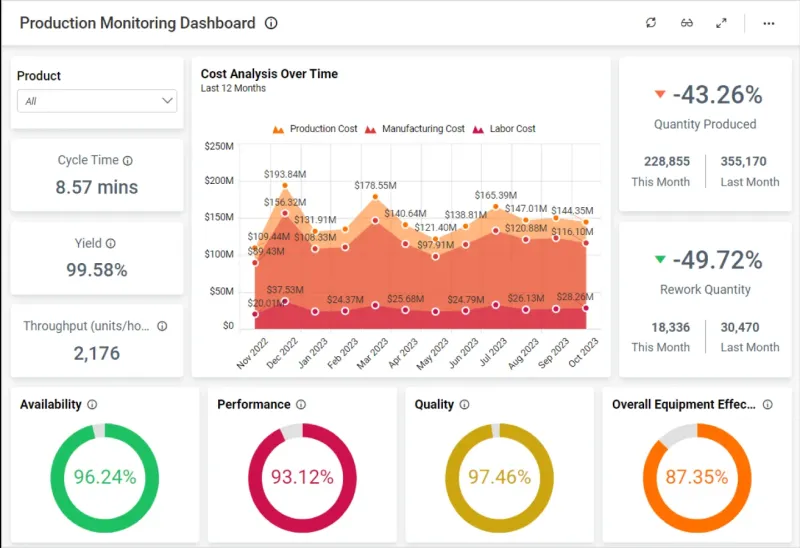
Photo: manufacturing production line cost analysis data dashboard, via cdn.boldbi.com
When a finance team reviews the cost of an OEM software integration project, the numbers on the spreadsheet represent only a fraction of the actual economic exposure. Labor rates, licensing fees, and consultant invoices are straightforward to capture. What rarely appears in any budget review are the costs that accumulate quietly in the background—eroding productivity, distracting skilled personnel, and narrowing the competitive window before anyone thinks to measure them.
For manufacturers operating in specialized or time-sensitive markets, these hidden costs are not rounding errors. In many cases, they represent the single largest financial consequence of a prolonged or poorly managed integration timeline.
The Throughput Gap Nobody Budgets For
Every week a production line operates on mismatched or partially integrated systems is a week in which output runs below its engineered capacity. This throughput gap is rarely framed as an integration cost, yet it is directly attributable to the delay.
Consider a mid-size manufacturer running a line rated for 1,200 units per shift. If integration friction—manual workarounds, duplicate data entry, system handoff errors—reduces effective output by even 6 percent, that represents 72 units per shift. At a modest per-unit margin of $40, a single shift absorbs a $2,880 shortfall. Across a standard 250-day operating year with two shifts, that figure reaches $1.44 million annually. No one writes a check for that amount. It simply disappears from revenue projections, misattributed to market softness or workforce variability.
Purpose-built OEM software eliminates this category of loss by design. When integration layers are engineered to match actual production logic rather than approximated through generic middleware, throughput operates at its intended rate from deployment forward.
Context-Switching and the Hidden Labor Tax
The second major cost category involves human capital, and it is arguably the hardest to quantify because it manifests as degraded cognitive output rather than overtime charges.
When technical staff—engineers, line supervisors, IT personnel—are required to manage workarounds for an integration that hasn't been fully resolved, they are not simply spending extra time on a discrete task. They are context-switching: moving their attention between the operational demands of their primary role and the administrative burden of compensating for software gaps. Research in organizational psychology consistently demonstrates that context-switching reduces the quality of output on both tasks simultaneously, not just the secondary one.
In practical terms, a senior process engineer spending 90 minutes per day reconciling data discrepancies between an OEM system and an ERP platform is not simply losing 90 minutes of productivity. That engineer is also arriving at the next design review or quality assessment with diminished focus. The compounding effect over a six-month integration delay is substantial, and it is never captured in a project post-mortem.
Custom OEM software, developed with the specific data flows and system interdependencies of a given operation in mind, eliminates the reconciliation burden entirely. The integration handles the translation; the engineer handles the engineering.
Market Timing: The Cost With No Recovery Path
Throughput gaps and labor inefficiencies are painful, but they can theoretically be recovered through increased output once the integration resolves. Market timing losses cannot.
In competitive manufacturing sectors—particularly those tied to product launches, contract cycles, or regulatory certification windows—the ability to bring a new capability to market within a defined period is often binary. Either the operation is ready when the window opens, or it is not. A delayed OEM integration that pushes a product line's readiness date past a key procurement cycle or trade show deadline does not result in a recoverable lag. It results in a missed opportunity that may not recur for 12 to 18 months, if at all.
This dynamic is especially pronounced for OEM suppliers serving original equipment manufacturers with rigid product development calendars. When a supplier's integration timeline slips, the downstream consequence is not merely internal disruption—it is a credibility event with a customer whose own schedule cannot flex.
Building a True Implementation ROI Framework
Given these cost categories, the standard ROI calculation for OEM software investment is consistently understated. A more accurate framework requires four components.
First, calculate the throughput delta. Identify the gap between engineered capacity and actual output under current integration conditions. Multiply the unit shortfall by margin per unit and annualize it. This is your baseline productivity loss.
Second, estimate the labor distraction cost. Survey technical staff to identify time spent on integration-related workarounds. Apply fully loaded labor rates and multiply by the anticipated duration of the delay. Adjust upward by 20 to 30 percent to account for context-switching degradation on primary tasks.
Third, assign a probability-weighted value to market timing risk. Identify the nearest market window—contract renewal, product launch, certification deadline—and estimate the revenue at stake. Apply a probability discount based on the likelihood that a delayed integration will cause a miss. Even a 25 percent probability against a $2 million contract represents $500,000 in expected value erosion.
Fourth, subtract the cost of a purpose-built solution. Custom OEM software carries a higher upfront investment than off-the-shelf alternatives, but when measured against the sum of the three cost categories above, the premium typically inverts within the first operating year.
The Compounding Nature of Delay
Perhaps the most important insight in this analysis is that integration delay costs are not linear—they compound. Each month of deferred resolution adds to the throughput gap, deepens the labor distraction burden, and moves the operation closer to a market timing cliff. Organizations that treat integration timelines as flexible administrative details rather than strategic financial variables tend to discover the true cost only in retrospect, when the losses have already been absorbed.
Precision-built OEM software is not simply a technical preference. It is a financial instrument. When the full cost of delay is properly accounted for, the investment case for a purpose-built solution becomes not just defensible, but difficult to argue against.